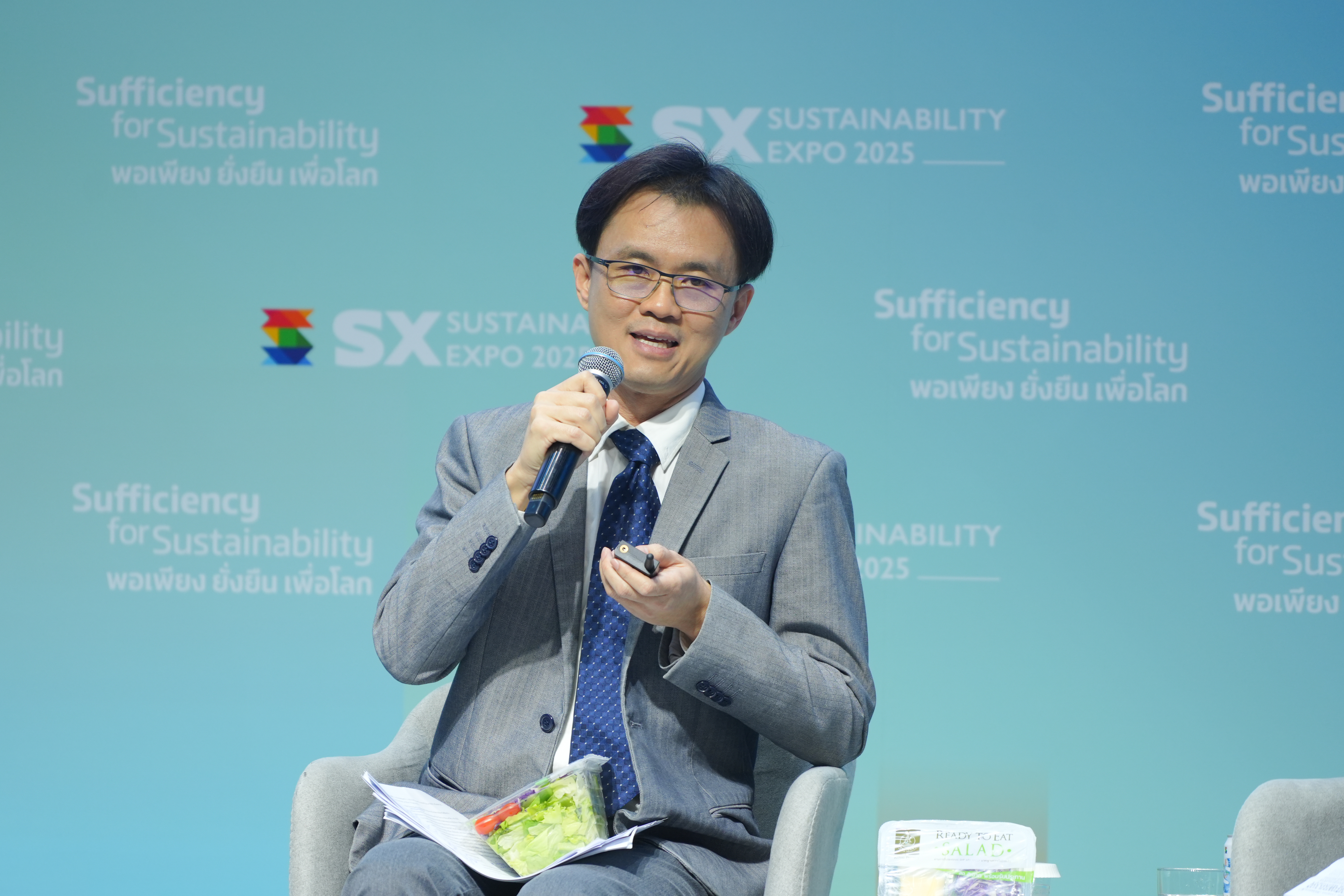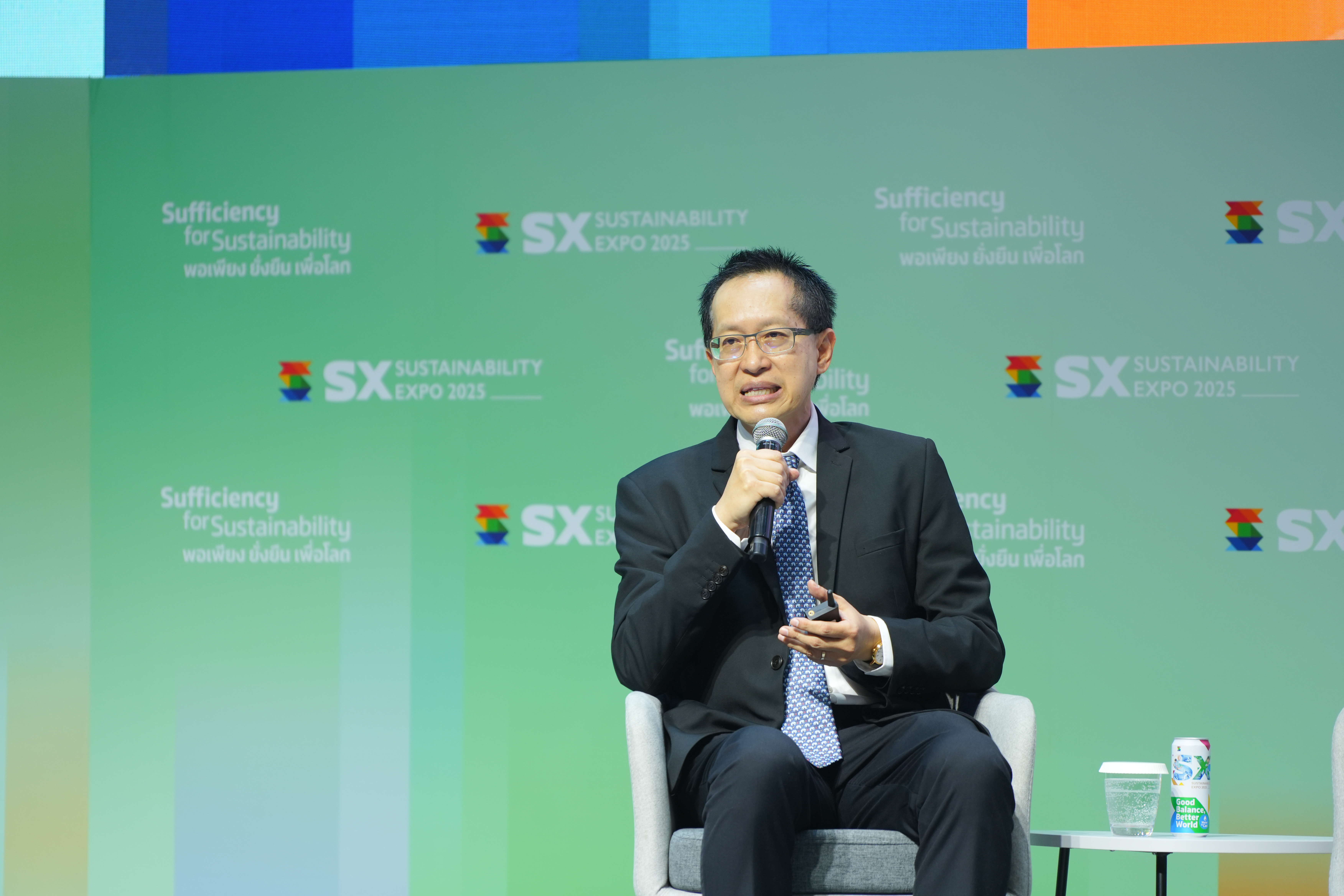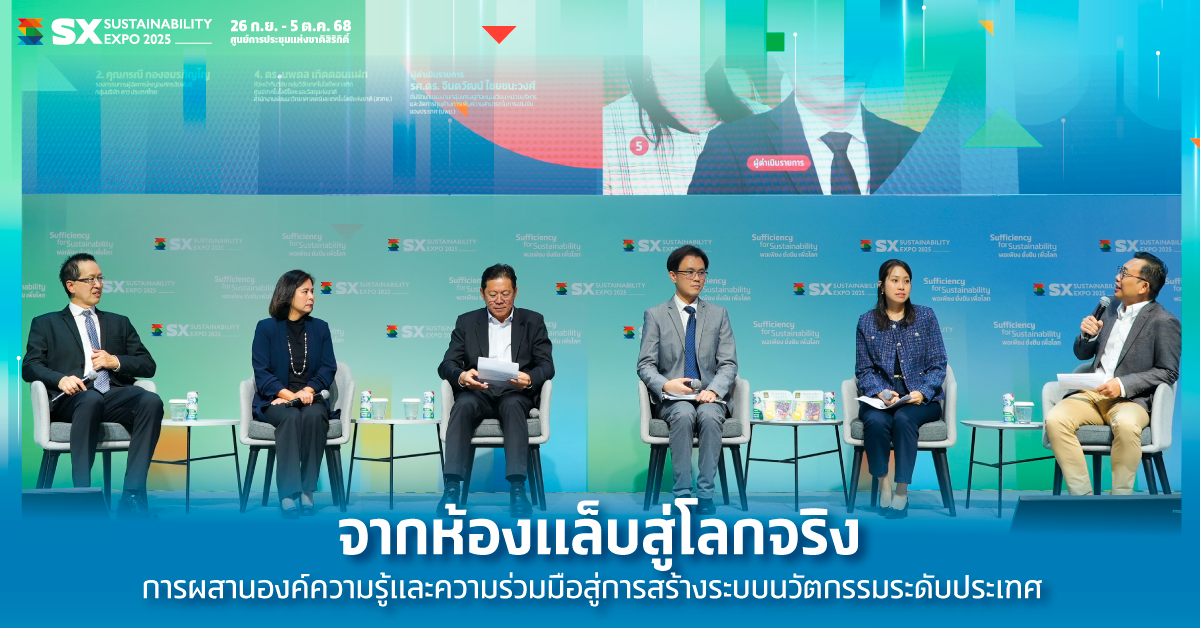
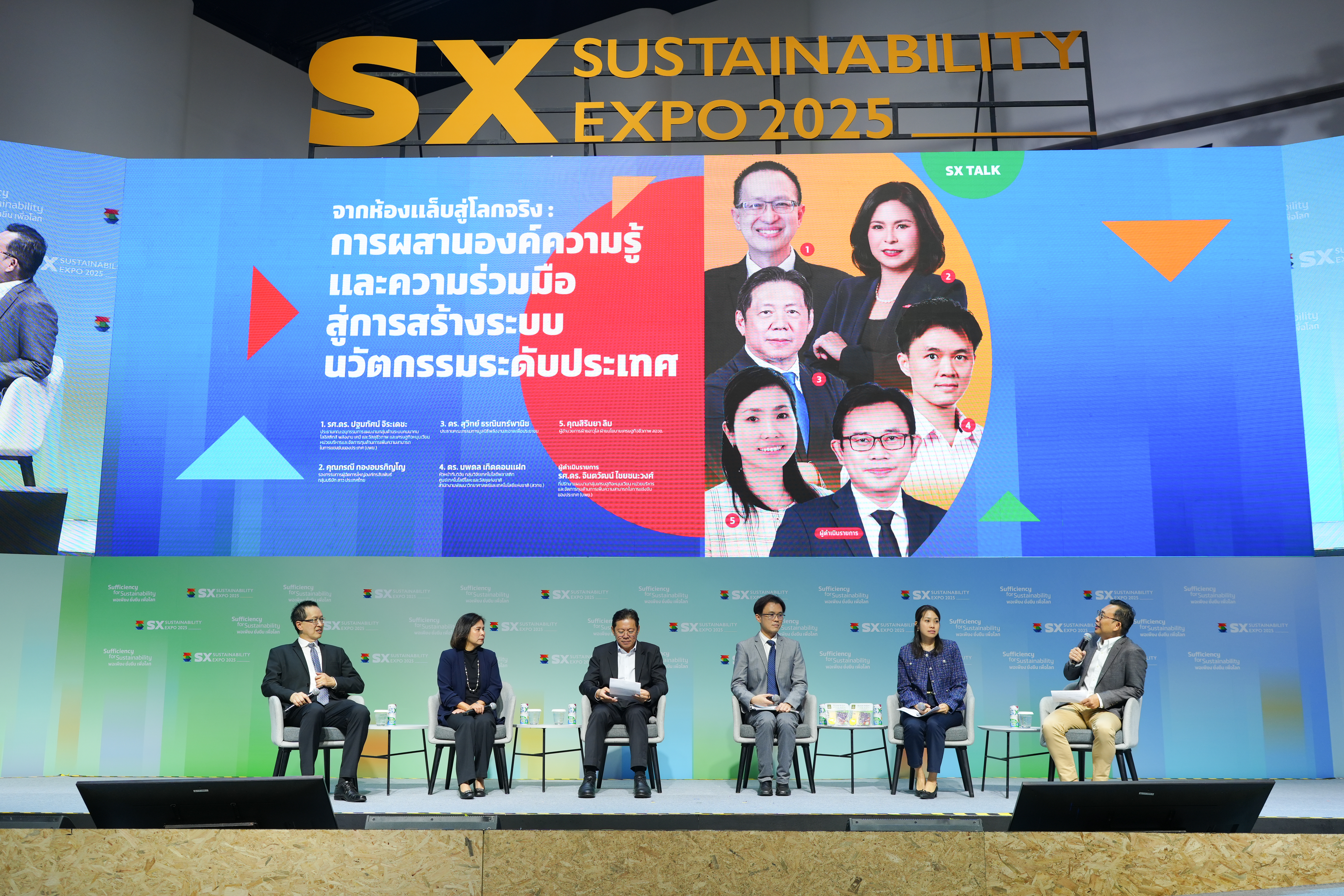
At the panel discussion “From Lab to Real World: Integrating Knowledge and Collaboration to Build a National Innovation System” at SUSTAINABILITY EXPO 2025 on 3 October 2025, the session brought together leading experts from Thailand’s research, policy, and private sectors. The panel featured Assoc. Prof. Dr. Pathomtat Chiradeja, Chair of the Subcommittee on Transportation, Logistics, Energy, Chemicals & Biobased Materials, and Circular Economy under the Program Management Unit for Competitiveness (PMU-C); Poranee Kongamornpinyo, Deputy Managing Director for Corporate Affairs at Dow Thailand Group; Dr. Nopadol Koetdonfaek, Research Team Leader of the Plastic Technology Research Group at the National Metal and Materials Technology Center (MTEC), NSTDA; Dr. Suvit Toraninpanich, Chairman of the Clean Energy for People Foundation; and Sirinya Lim, Senior Director of the Bioeconomy Policy Division at the Office of National Higher Education, Science, Research and Innovation Policy Council (NXPO). The discussion was moderated by Assoc. Prof. Dr. Jintawat Chaichanawong, who guided the conversation on how cross-sector collaboration can accelerate national innovation.
The Program Management Unit for Competitiveness (PMU-C) plays a crucial role in accelerating innovation toward commercial application. Its work has led to notable success in research projects it supports, particularly in the areas of Circular Economy, Energy, and Bio-Economy—fields that are essential for generating positive impact and laying the foundations for long-term sustainability. PMU-C’s mandate is to fund, expand, and scale research while strengthening the link between laboratory-based knowledge and real-world private-sector implementation.
Although Thailand has seen a significant rise in knowledge creation and academic publications, the transition from research to commercialization remains critical. With GDP growth projected at only 2 percent and the country entering an aging society, the existing economic structure will not be sufficient to meet emerging challenges. Building new industries to replace declining ones has therefore become a national priority.
Research focused on energy and circular economy systems is especially important for achieving both national and global climate goals. These efforts directly support Thailand’s commitments to Carbon Neutrality and Net Zero—targets that the country aims to accelerate by 15 years—highlighting the urgency of transforming scientific knowledge into scalable, commercially viable, and future-ready solutions.
PMU-C is designed to reduce risk for both the private sector and researchers by offering a variety of funding mechanisms.
It can provide 100% funding to research-focused institutions such as NSTDA, with the condition that there must be a clearly identified end user or beneficiary in the private sector.
For private companies, a minimum co-investment of 10% is required; however, firms that invest more than 10% receive an advantage during evaluation, as this demonstrates a strong commitment to applying the research in real practice.
In the case of publicly listed companies or large corporations, funding may follow a 50–50 co-investment model, depending on performance and intended utilization. Importantly, there is no upper limit on funding, allowing high-potential projects to scale without restriction.
Successful Innovation Project
Biodegradable Packaging Material
The research project “Biodegradable Packaging Material” led by Dr. Noppadon Kerddonfag of the National Metal and Materials Technology Center (MTEC), NSTDA, successfully developed a transparent biodegradable film with anti-fog properties (Bi-Ad). This material is 100% biodegradable and made entirely from domestically sourced raw materials, such as starch and sugar. With a Technology Readiness Level (TRL) of 9, the innovation has already been commercialized. Biodegradable packaging presents a promising solution for the food industry, offering environmental benefits while addressing the limitations of natural materials like banana leaves, which—though eco-friendly—cannot meet industrial-scale production demands in the same way plastic can.
The transition from laboratory-scale production (9 kg per hour) to industrial-scale production (250 kg per hour) carried significant risks, particularly the high cost of trial production using factory-grade machinery. Any failure during scaling up could result in an entire batch being discarded.
This success, however, was made possible through full value-chain collaboration—from plastic pellet producers to film converters and brand owners such as Thantawan Industry Public Company Limited—combined with PMU-C’s risk-sharing support throughout the development process. Today, the product is available at Doi Kham stores and at Royal Project retail outlets across Bangkok.
Reflecting on the project, Dr. Noppadon Kerddonfag emphasized: “Government support for the private sector and researchers is what enables lab-scale research to be further developed and applied in real life.”
Plastic Circular Economy Ecosystem
The Plastic Circular Economy Ecosystem Project by Dow Chemical (DOW)—a global materials science company—aims to advance sustainability by ensuring that by 2030, all of its packaging products will be recyclable, and that 3 million tonnes of plastic waste will be brought back into the production cycle.
Ms. Poranee Kongamornpinyo explained that Dow co-founded PPP Plastics in 2018 to drive the circular economy in Thailand. The key insight from their work was that, although Thailand possesses excellent end-of-life recycling technologies—producing premium-grade recycled plastic—it lacks systemic solutions at the upstream (serious waste sorting) and midstream (traceable collection systems). With support from PMU-C, Dow received funding to develop the Ban Chang MRF, Thailand’s first modern materials recovery facility. The project uses advanced sorting technology developed by the Thailand Institute of Scientific and Technological Research (TISTR) and is implemented in collaboration with the Ban Chang Subdistrict Municipality.
Operated as a social enterprise, the facility can sort up to 5 tonnes of materials per day while creating income opportunities for the community. The success of this model enabled PPP Plastics to secure international grant funding from the Alliance to End Plastic Waste, allowing the initiative to scale into the Eastern Hub, which aims to collect 50,000 tonnes of high-quality plastic per year.
A core component of the project focuses on the formalization of informal workers, such as waste pickers and small recycling shops, bringing them into a transparent, registered system—an effort also supported by PMU-C. As Ms. Poranee explained, Dow’s work reflects the company’s belief that “producing products that help care for the planet, supported by informed customers and an engaged society, enables us to bring sustainability into real-world practice.”
Voluntary Household Carbon Market
“Global warming has become a trade instrument for major powers. This issue is not distant from our lives. We must open our eyes and our minds to prepare ourselves,” remarked Dr. Suwit Toraninpaanit as he introduced the Voluntary Household Carbon Market Project, initiated by the Clean Energy for People Foundation. The project was created to bridge the gap between government agencies and universities on one side, and the private sector on the other. Using an Eco Business Model, it incentivizes households by offering rewards: families that install solar panels—primarily to save on electricity bills—can also earn certified carbon credits verified by academic institutions. These credits are automatically converted into loyalty points with major retail partners such as The One and HomePro.
The pilot phase, involving the first 300 households, was challenging. Many residents viewed the project as unfamiliar—so unfamiliar that some thought it was a scam. The foundation had to go door-to-door to build trust. Acting as a “ten-direction connector,” the foundation brought together startups (to build the digital platform), PMU-C (as the funding agency), academic institutions (as verification bodies), and leading retailers to form a unified ecosystem.
To date, the project has generated 2,700 kilograms of carbon credits, equivalent to 370,000 The One points (with an exchange rate of 1 ton of carbon = 1,600 The One points). This initiative has transformed the complex and seemingly distant concept of carbon credits into something accessible, practical, and participatory—allowing everyday households to meaningfully contribute to protecting the planet.
Synthetic Biology (SynBio)
The Synthetic Biology (SynBio) initiative focuses on creating or engineering new biological systems using engineering design principles, enhanced by AI and computational tools to accelerate biological processes. This technology is considered one of the most significant future disruptions. A familiar example is the mRNA vaccine. SynBio enables faster and more cost-effective development of new medicines, environmentally friendly chemicals, and a wide range of novel plant varieties.
Applications in the food sector include engineering plant cell biology to reduce food waste and developing crop varieties that require fewer pesticides. Engineered bacteria are used to produce high-value natural compounds, such as bio-based fragrance ingredients, at large scale and high speed while consuming fewer natural resources. SynBio also supports the production of high-strength protein fibers like spider silk. Thailand is well positioned to become a production base for these materials due to its abundance of key raw inputs—particularly sugar.
Ms. Sirinya Lim of NSTDA highlighted the importance of governance, noting that: “Policy continuity is essential. When we allocate part of the national budget to research development, we must ensure transparency and smart budget management to maximize public benefit.”
SynBio will play a critical role in helping Thailand achieve its Net Zero goals across several sectors, including agriculture, food, energy, and healthcare. Thailand has already established a Synthetic Biology Consortium to advance this technology. Key drivers for progress include: policy stability and regulatory support that encourages industrial development, knowledge building, supported by research centers and career pathways for scientists, and technology development, including pilot plants, business-support systems, and strong intellectual property management frameworks
Together, these elements will enable Thailand to harness the full potential of SynBio and strengthen its position in the global bioeconomy.
Policy and Regulatory Recommendations
Both the public and private sectors emphasized that policy continuity is the single most critical factor. The private sector expressed the need for the government to designate the circular economy as a long-term national priority—not merely a temporary trend—so that private investment and research efforts can progress without disruption. Businesses also urged the government to revise regulatory barriers that hinder development and slow market activation. Clear, supportive regulations would help consumers understand and adopt recycled materials in daily life. In addition, stakeholders stressed the importance of smart and transparent budget management, ensuring that national funds are allocated for maximum benefit and that relevant stakeholders are included in decision-making processes.
Ecosystem Readiness
Thailand has highly capable researchers and a committed private sector eager to commercialize scientific knowledge. However, if the country fails to transfer knowledge from laboratories to real-world application, it risks facing significant challenges in the future. PMU-C reaffirmed its readiness to serve as a key part of this ecosystem by driving technology transfer, guided by its principle that “we move together and win together” for the benefit of the nation and society. Achieving this vision requires the integration of knowledge, funding, policy, and cross-sector collaboration—a unified effort that will create a strong and sustainable foundation for Thailand’s future.
Gallery