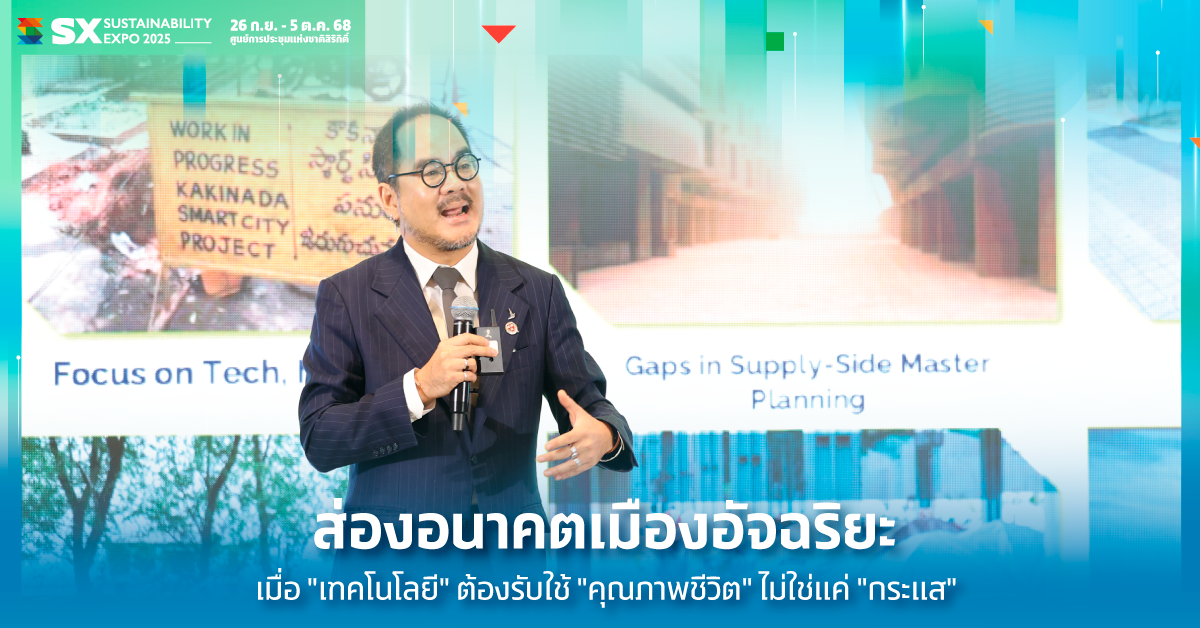
Amidst the surging tide of technology—including AI, VR, and the Metaverse—the critical question echoing through urban development is: Are we merely "hyped up" (บ้าเห่อ) on innovation, or are we genuinely building a "livable future" for people?
The "Sustainable and livable City Expo (SLiCx)" panel, held within the Sustainability Expo 2025 (SX2025) at the Queen Sirikit National Convention Center, became a key landmark in answering this question. It gathered forces from the public and private sectors, along with both Thai and international entrepreneurs, to collaboratively design the future of sustainable and more livable smart cities.
"Understanding Citizens" is Key, Even with Good Intentions and Money
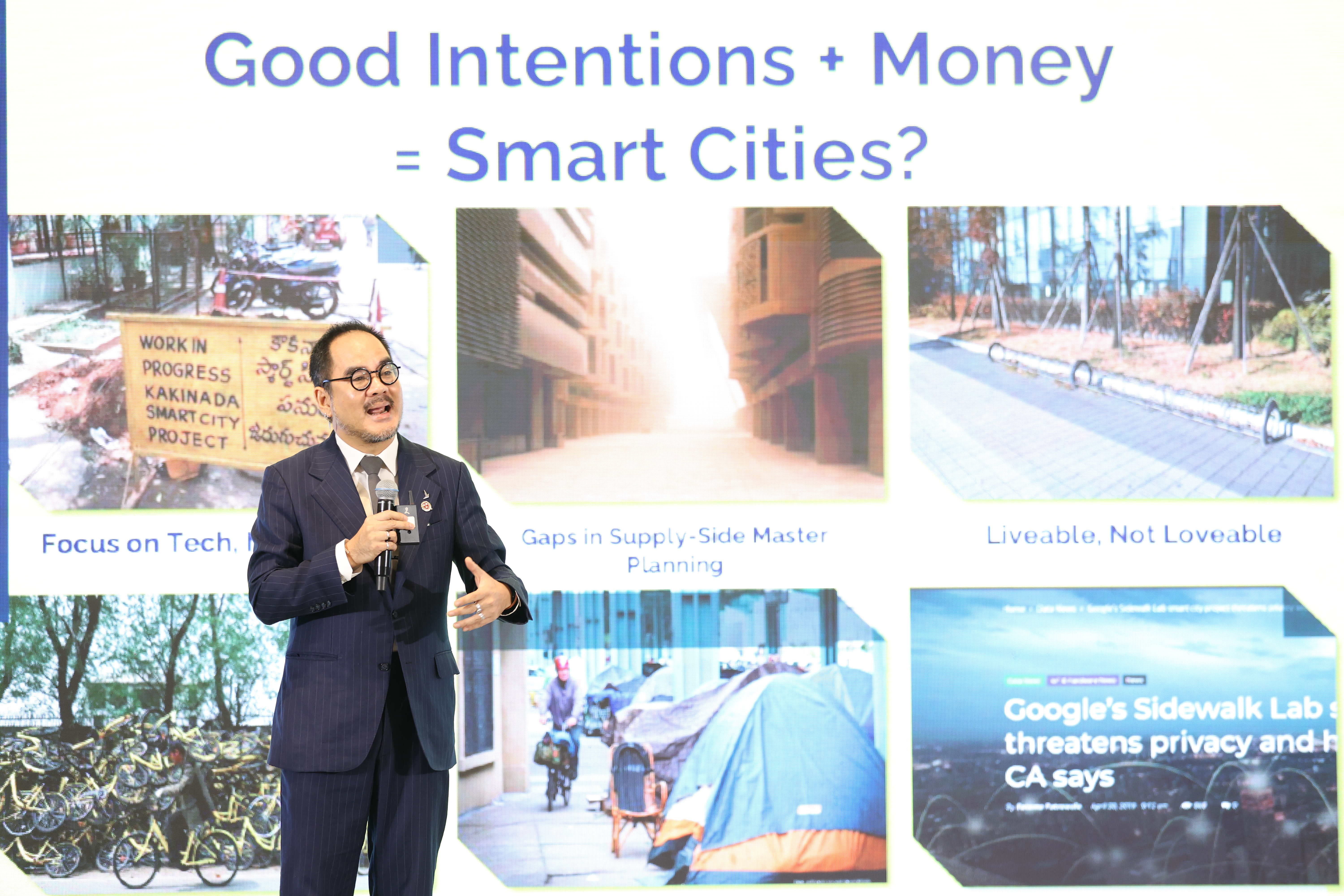
The highlight began with the panel "What’s a citizen-centric smart city?" where Dr. Non Akaraprasertkul, Senior Expert at the Smart City Promotion Department (depa), raised a compelling point: "Even with good intentions and money, if we don't understand the citizens, it's just wasting money." He proposed a 4P (Purpose, Practical, Proof, People) approach to create a city driven by public participation.
Dr. Non cautioned against the "hype" surrounding technology use and concluded that technology should manage tasks that are "dangerous," "boring," or "repetitive," in order "to give us humans time to take walks, time for further education, and time to give love to one another.”
Tangible Innovations: From Home Dust Meters to Personal Carbon Credits
The event also showcased tangible solutions in the "Clean air for all" Business Presentation session, which was part of a Pitch Competition for investors. Several notable innovations were featured:
-
Pangen Company: Launched "Carbon Act," an AI platform for calculating greenhouse gases, proving more accurate than humans and reducing costs and time by 60%.
-
Vekin Company: Presented the "CERO platform," which converts daily eco-friendly behaviors, such as avoiding plastic or planting trees, into Personal Carbon Credit.
-
Alertgenz Company: Unveiled "Alex-X," an indoor dust mite meter designed to solve allergy problems, as nearly 80% of Thais are allergic to dust mites.
-
Moreloop Company: An online marketplace that repurposes textile waste from the fashion industry, thereby reducing CO2 emissions.
-
Planetcomm Public Company: Presented the development of SOS and Command Center systems to upgrade the 191 emergency notification system for greater speed and accuracy.
Global Voices: "Long-Term Benefits" and "Data" Are Key
A global perspective was shared by Mr. LUIS MAO, CEO of the SMART CITY EXPO WORLD CONGRESS (SCEWC), who serves as a "middleman" connecting supply and demand, ready to support investment for companies with targeted solutions.
Meanwhile, the "Smart & Livable city : urban city development” panel reflected real-world implementation. Mr. Paul Kanjanapas (Bangkok Land) mentioned an application that assists with bill payments, noting that while not new, it "gives life and time back to people to live more." Mr. JY Chen (iWOW Technology) pointed out that their data was a key factor in helping Singapore limit deaths to just 350 out of 1 million people during the COVID lockdown.
Ms. Grace de Leon from the Christchurch City Council, New Zealand, shared her strategy for negotiating with authorities, stating that one must demonstrate "benefits beyond money" and the long-term ROI (Return on Investment), rather than focusing solely on short-term gains.
The Future of Logistics: The Private Sector Needs "Clear Policies"
The discussion concluded with the "Smart logistics" panel, which looked toward future infrastructure. Mr. Chavachit Sundarasaradula (Thailand Post) discussed the "digital mailbox" plan, which will shift from "physical touch" to "digital touch" to reduce carbon.
Mr. Nattaphum Paowarut (SCGJWD Logistics) frankly echoed the private sector's sentiment: "What will truly push the private sector is the government setting clear and precise policies." He noted that the current environment is "everyone doing their own thing" (ต่างคนต่างทำ), and stable policies are necessary. The session ended with a powerful conclusion from Mr. Santisuk Klongchaiya (Asia Aviation): "We must make the city smart and livable, not just for our generation, but for the next one as well."