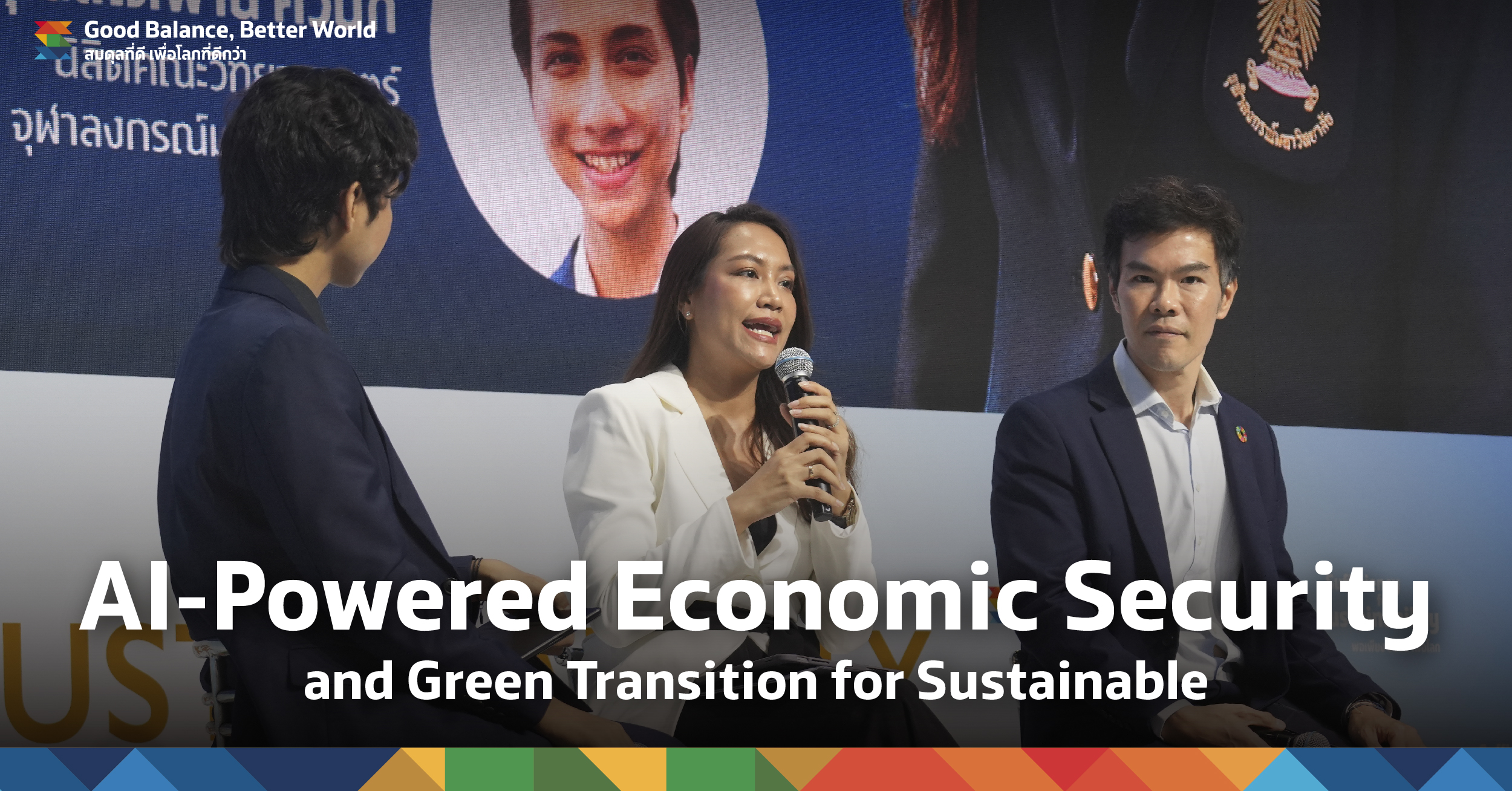


AI as a Driver of the Green Transition and a Sustainable Future
AI is no longer just a tool for boosting productivity or a chatbot that retrieves information on command. It now plays a crucial role in enabling the green transition and supporting a more sustainable future. AI helps manage energy more efficiently, reduce energy consumption and emissions, and analyze climate data—empowering humanity to respond quickly and minimize damage.
How Can AI Drive the Green Transition and Sustainability?
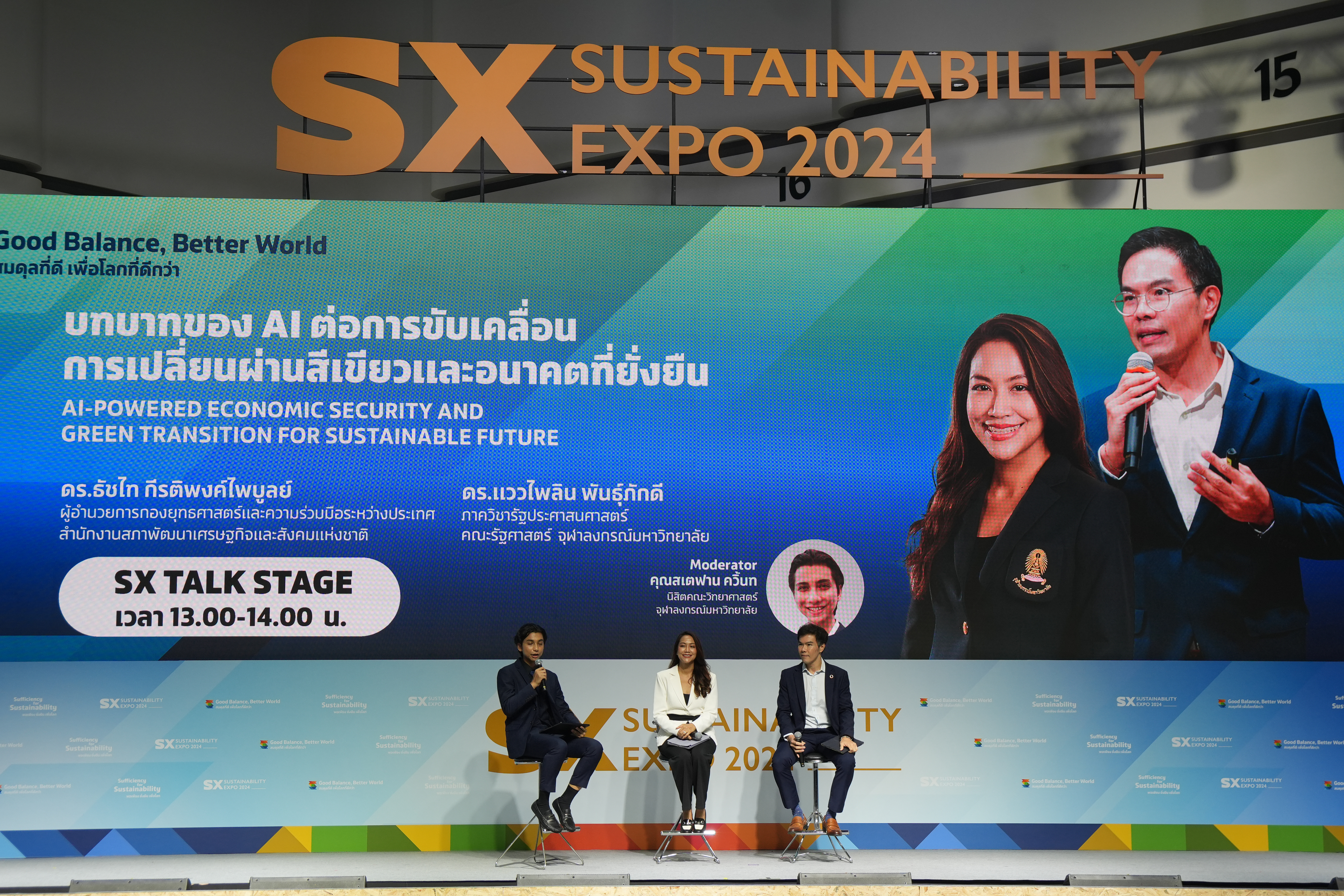
Despite these potentials, there are still considerable challenges to AI adoption—ranging from usage behavior and public attitudes to widespread misconceptions about the technology. These issues were discussed at a panel titled
"AI-Powered Economic Security and Green Transition for Sustainable Future" at Sustainability Expo 2024 (SX2024), held at Queen Sirikit National Convention Center.
Featured speakers included:
-
Dr. Thatchatai Keeratipongpaiboon, Director of Strategy and International Cooperation Division, Office of the National Economic and Social Development Council (NESDC)
-
Dr. Waewpailin Phanphakdi, Faculty of Political Science, Department of Public Administration, Chulalongkorn University

Addressing AI’s Challenges
Dr. Thatchatai noted that with AI becoming increasingly integral to daily life, new professions must emerge to meet related challenges. For instance, data science professionals are essential for filtering accurate information and ensuring responsible AI development and deployment.
Because AI systems can process both accurate and inaccurate inputs, misinformation and disinformation—often fed into systems by humans—can skew AI results. As such, users must develop critical thinking skills to discern data quality and maintain the reliability of AI outputs.
Moreover, deliberate manipulation of AI systems with false inputs could cause confusion. Careful and responsible AI use is therefore necessary to maximize the benefits while minimizing risks.

Building AI Literacy and Human-AI Collaboration
According to Dr. Waewpailin, AI literacy is vital. Users must build familiarity with AI through hands-on experience. A strong understanding of how AI functions allows users to critically interpret its outputs—whether accurate or flawed.
Human oversight is thus essential, enabling a collaborative relationship between humans and AI. This human-AI synergy will become a key competency in future workplaces—complementing traditional human teamwork and enabling smarter, more efficient problem-solving.
The Role of Government in AI Regulation and Development
Dr. Thatchatai emphasized that the government has a key role in overseeing responsible AI use—particularly in personal data protection. Government agencies must not only support AI adoption but also update regulations quickly to keep pace with digital transformation. This process, known as agile regulation, ensures that AI can be deployed safely and constructively.
While AI is a powerful tool, it should enhance rather than replace human capabilities. Humans must remain at the center of decision-making and innovation, with AI supporting and optimizing performance.
Dr. Waewpailin added that governments should also invest in digital and data security training—equipping personnel to design resilient systems and ensure cybersecurity. This includes establishing regional AI education centers and offering scholarships to cultivate technical expertise.
Additionally, reskilling and upskilling public- and private-sector workers will be crucial for advancing a sustainable digital society.
Using AI to Combat Climate-Driven Disasters
Dr. Waewpailin also addressed the use of AI in disaster risk reduction, particularly in collaboration with the Ministry of Natural Resources and Environment. She noted that data collection and climate analysis are often too complex for humans to perform unaided.
AI helps monitor high-risk areas using sensor data—such as on dams or fragile landscapes. It can predict disasters like floods or earthquakes, issue early warnings, and help reduce damage. In inaccessible or dangerous zones, AI bots can transmit real-time data, enabling rapid response by authorities.
AI technology is thus an essential tool for disaster preparedness and management in a changing climate.
AI and Energy Sustainability
Dr. Thatchatai also discussed how AI supports energy sustainability, particularly by optimizing energy use in business and industry. AI can minimize unnecessary consumption and enhance resource efficiency. For example, placing data centers in cooler regions or using renewable energy sources such as wind or hydropower can significantly reduce environmental impact.
One notable case is South Korea, where a startup has used AI to analyze business energy consumption—cutting usage by 30–40%. This demonstrates how AI can improve energy efficiency and reduce emissions in the industrial sector.
Looking forward, sustainable innovation will be crucial for both economic and societal development. Building sustainable AI systems that benefit all sectors will require adaptive thinking and openness to new technologies.
AI, Big Data, and Future Innovation
Dr. Waewpailin further noted that AI and Big Data play pivotal roles across industries. Besides driving innovation, they also help lower operational costs. Leading tech firms like Microsoft and Google have built data centers in cooler climates such as Northern Europe or even under the ocean to reduce energy use.
Microsoft, for example, leverages wind and hydro energy to power its systems, underscoring a strong commitment to sustainability.
As AI continues to evolve, more companies are expected to shift toward 100% renewable energy to power their data systems—ushering in a new era of green technology.
Stay Updated with SX
Stay informed about SX events and initiatives via the [Facebook Page: Sustainability Expo] Or add them on LINE: @sxofficial
Don’t miss SX2025, which returns bigger and better than ever from September 26 – October 5, 2025, at Queen Sirikit National Convention Center.