
In an era where disasters strike without warning, the most critical question is: How quickly can we 'reach' every citizen through what many call Thailand's '33rd organ'—the ever-present smartphone?
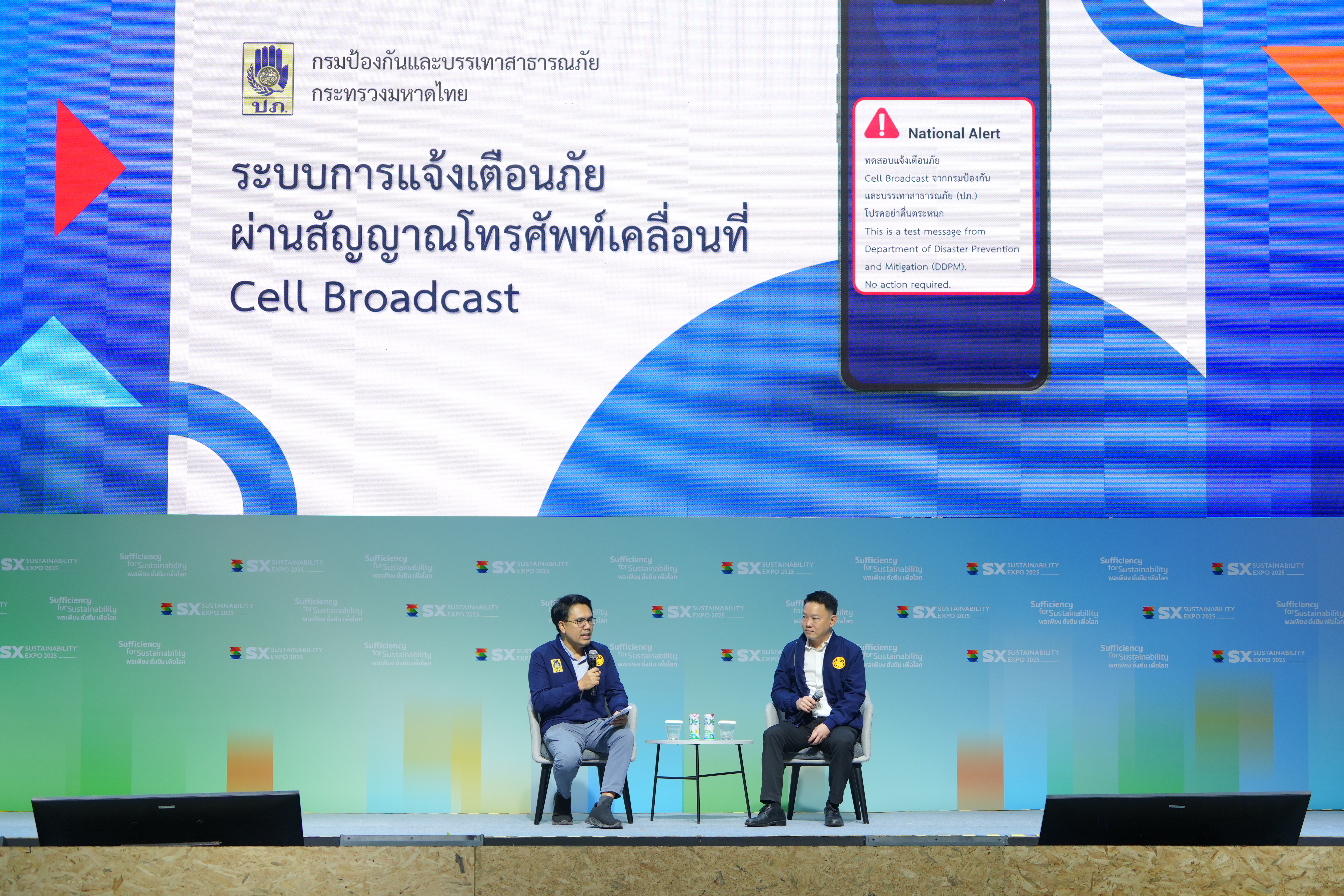
This discussion was held on the SX TALK STAGE as part of SUSTAINABILITY EXPO (SX2025), ASEAN's largest sustainability exposition, under the topic "Development of a Disaster Warning System via the CELL BROADCAST Mobile Signal."
The expert speakers who clarified and recounted the development of this critical system were Mr. Phumarin Taowarodom, Director of the Alert Strategy Division, National Disaster Warning Center, and Mr. Arm Jittanadilok, Director of the Academic Alert Division, National Disaster Warning Center. Both represent the National Disaster Warning Center (NDWC), under the Department of Disaster Prevention and Mitigation (DDPM), Ministry of Interior.
From the Lessons of the Tsunami to the Integration of ‘T Alert’
Mr. Arm Jittanadilok recounted the origin of the NDWC, which was born from the Tsunami of December 26, 2004. At that time, Thailand lacked a timely surveillance or warning system, resulting in economic losses totaling over 14 billion THB. Consequently, the government established the NDWC. Today, the center operates under the DDPM, Ministry of Interior, with two locations: an administrative section in the Dusit district and the warning operations section, located within the Thai Meteorological Department in Bang Na.
The center's initial critical mission was to respond to disasters like tsunamis, which included deploying two tsunami detection buoys in the Indian Ocean and the Andaman Sea, and installing over 130 warning towers along the six Andaman coastal provinces.
However, the DDPM's mission is broader than just tsunamis, covering disaster management before, during, and after an event. This led to the further development of the warning system to reduce risk in the pre-disaster phase, ensuring the public and officials are prepared to respond.

Cell Broadcast: Why It Is the Best Choice for Warnings
The speakers highlighted a major historical problem: the public often stated that warnings were "not thorough and did not reach them personally." Today, however, mobile phones or smartphones are a widespread technology. Approximately 90% of people in Thailand have a mobile phone, and globally, the ITU found that about 80% of the world's population has one.
Cell Broadcast (CB) was therefore adopted as a warning system capable of transmitting signals—including text, symbols, colors, and sound—to every mobile phone within a designated area.

Key Features of Cell Broadcast:
-
Rapid Reach: CB has its own special channel or "expressway," allowing for faster, simultaneous alerts.
-
No Internet Dependency: The CB system does not require an internet connection to receive signals and is not limited by voice call channels, which are often congested during major events like earthquakes.
-
No Application Download Needed: The system works directly with the Cell Site (signal tower). The public does not need to install any additional applications.
-
Geographic Precision (Microscale): The transmission area can be precisely defined, from the building level, to the district level, or the provincial level.
-
Repeated Alerts/Delay: Broadcasts can be timed. If set, anyone entering the warning area will receive the alert immediately. However, a phone that has already received the signal will not receive it again upon re-entering the same area.
-
Extreme Volume Level: For the most severe (National Alert) warnings, the phone will sound a very loud alarm, even if the user has muted it.
The development of the Cell Broadcast system is an integrated collaboration, with the DDPM acting as the sender (CBE - Cell Broadcast Entity). It works with the Ministry of Digital Economy and Society (DE), which provides the infrastructure to link the signal to the three main mobile operators—AIS, True, and NT (National Telecom)—which serve as the intermediaries (CBC - Cell Broadcast Center) distributing the signal to Cell Sites nationwide.
The 'T Alert' (Thailand Alert) System
Mr. Arm Jittanadilok explained the integration of the national warning system, called T Alert (Thailand Alert), which signifies Thailand's integrated, multi-channel approach to public warnings.
Currently, Cell Broadcast supports 8 types of disaster warnings:
-
Earthquake (notification of event)
-
Tsunami (can provide advance warning of approx. 45 mins to 1 hour)
-
Storms (Rainstorms/Tropical storms)
-
Floods
-
Mudslides
-
Cold surges
-
Fine particulate matter (PM 2.5)
-
Threats from violent incidents in public areas (under discussion with police)
The Cell Broadcast system has 4 alert levels:
-
National Alert: Highest severity. The phone will ring loudly and cannot be silenced.
-
Extreme Alert: On Android systems, the sound can be muted, but the message will still appear.
-
Informational Alert: Data-centric alerts (e.g., storm formation). A pop-up will appear with one short "beep."
-
All Clear: Notification that the threat has passed.
Furthermore, the NDWC utilizes many other channels under the T Alert system, such as warning towers, official documents, LINE groups, SMS, the Thai Disaster Alert (TDA) application, and various social media platforms (Facebook, X, TikTok). Mr. Phumarin Taowarodom emphasized that for warnings, "the more, the better," as each channel has different limitations.

The center's operations require 24/7 integrated cooperation with data-providing agencies, such as the ONWR, the Meteorological Department, the Royal Irrigation Department, the Department of Water Resources, and the Pollution Control Department. He stressed that the best alerts should originate from the local level (Local Alert), while the central authority acts as a supporter, disseminating information with available technology.