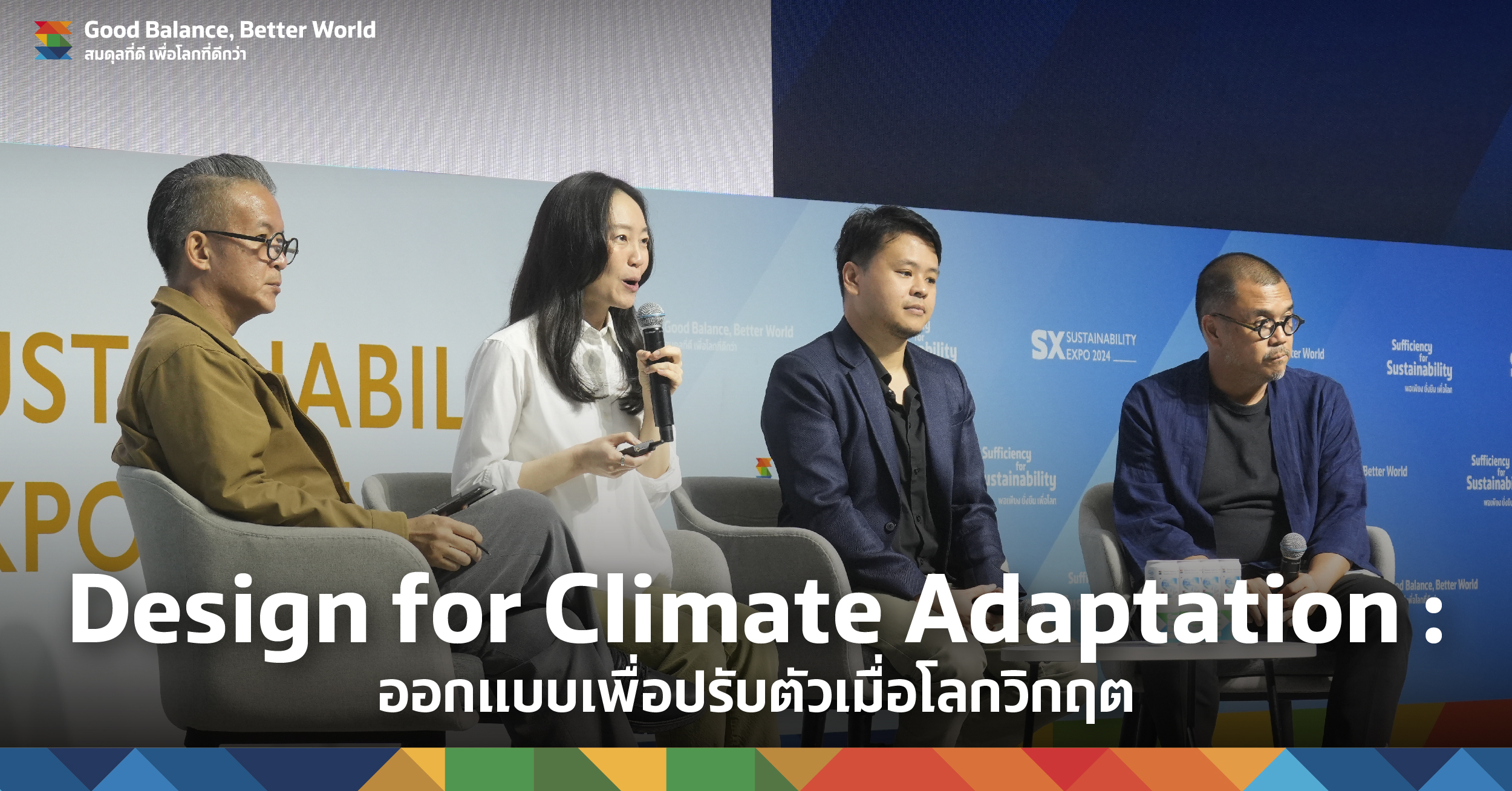
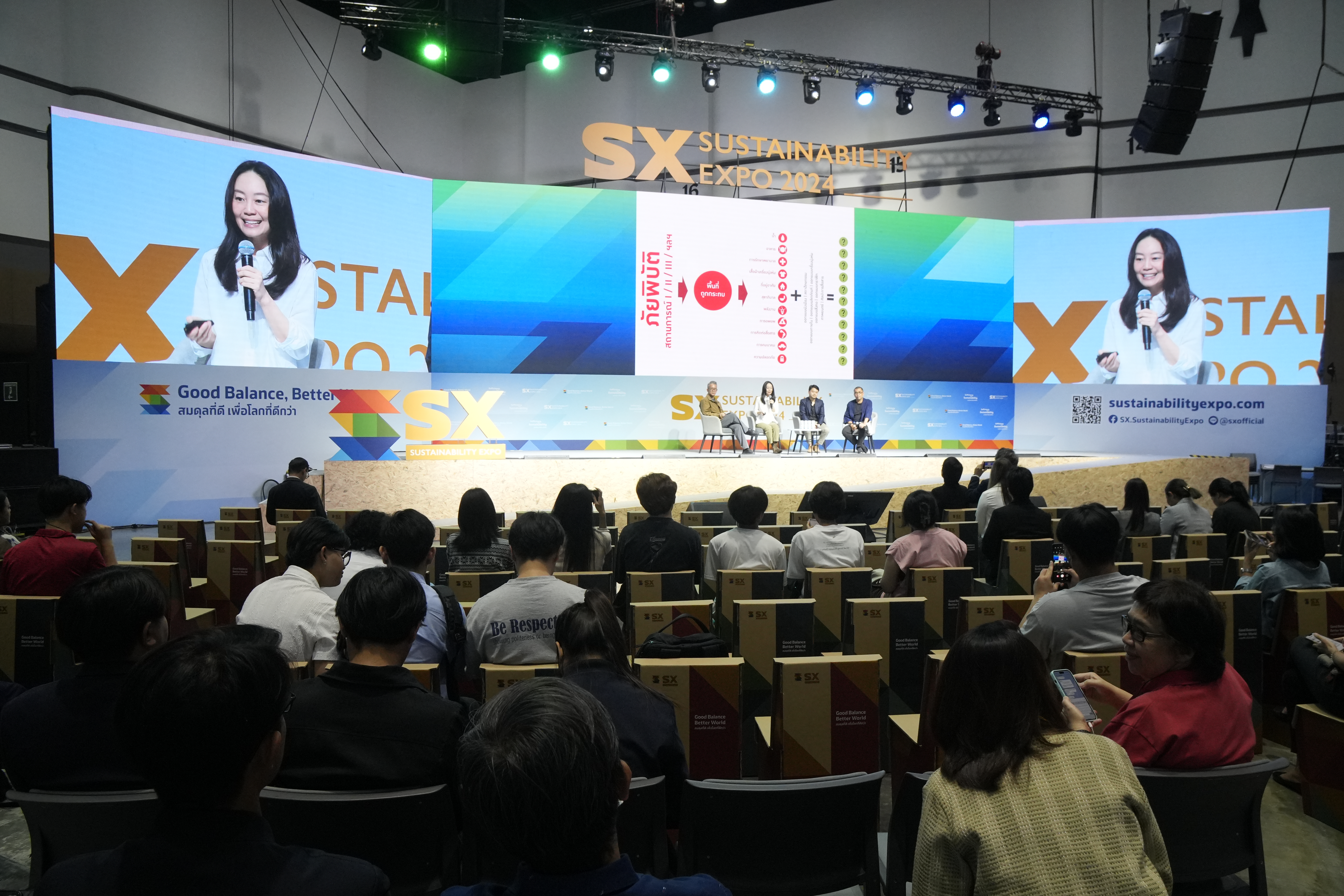
As climate change increasingly disrupts ecosystems, societies, and economies worldwide, adapting to these changes has become not just necessary but urgent. The panel discussion “Design for Climate Adaptation: Rethinking Our Future in a Crisis-Stricken World” at the Talk Stage of SUSTAINABILITY EXPO 2024 (October 3, 2024) brought together leading voices across disciplines to explore how design can be leveraged to mitigate the severity and risks of climate-related impacts.
Panelists included Chutyawej Sindhuphan, Chief Sustainability Officer at the Institute of Agro-Natural Architecture for Urban and Rural Ecosystems (NAATURE); Wipavee Kunavichayanont, Co-founder of the Design for Disasters Foundation (D4D); Dr. Polpat Nilubon, Head of the Water Adaptation Innovation Center (WAIC); and Assistant Professor Komkrit Thanapetch from the Department of Urban and Regional Planning at Chulalongkorn University, who moderated the session.
Rethinking Risk Through Design
Wipavee Kunavichayanont introduced the concept of the Butterfly Effect—how seemingly minor natural changes can trigger far-reaching consequences. She cited a massive 200-meter tsunami in Greenland that lasted nine days, caused by distant melting glaciers. Wipavee reminded the audience that humanity lives on a thin crust of earth floating atop magma, and disruptions in one area can reverberate globally.
She emphasized that while natural disasters are often beyond our control, choosing to live near high-risk zones necessitates proactive planning and design interventions. “Architecture, interior design, fashion, product design—even visual communication—can all strengthen our resilience,” she said. She highlighted vernacular knowledge, such as the bamboo homes in Surat Thani’s Tha Khanon community, which float and are tethered to posts to withstand flooding.
Japan's example of constructing increasingly taller seawalls also shows that even advanced infrastructure has its limits, reinforcing the importance of flexibility in design. Wipavee likened society to a jar filled with rocks of different sizes—the state being the large stones and citizens the small ones. “We must all make use of our shared resources without harming one another,” she explained.
When asked how designers and artists can foster adaptation, she responded: “As designers and human beings, we must distinguish between what’s essential and what’s merely desirable. With limited resources and time, we must make mindful, priority-based decisions. Design is, in essence, a form of decision-making.”

Designing at the Middle Layer
Dr. Polpat Nilubon highlighted that the term resilience has become central in climate conversations, but implementing it is not always straightforward. He explained that adaptation typically occurs at two extremes: top-down government megaprojects—like massive underground tunnels—and bottom-up grassroots efforts, such as raising homes. However, these rarely resolve the core issue, and flooding, for example, continues to recur annually.
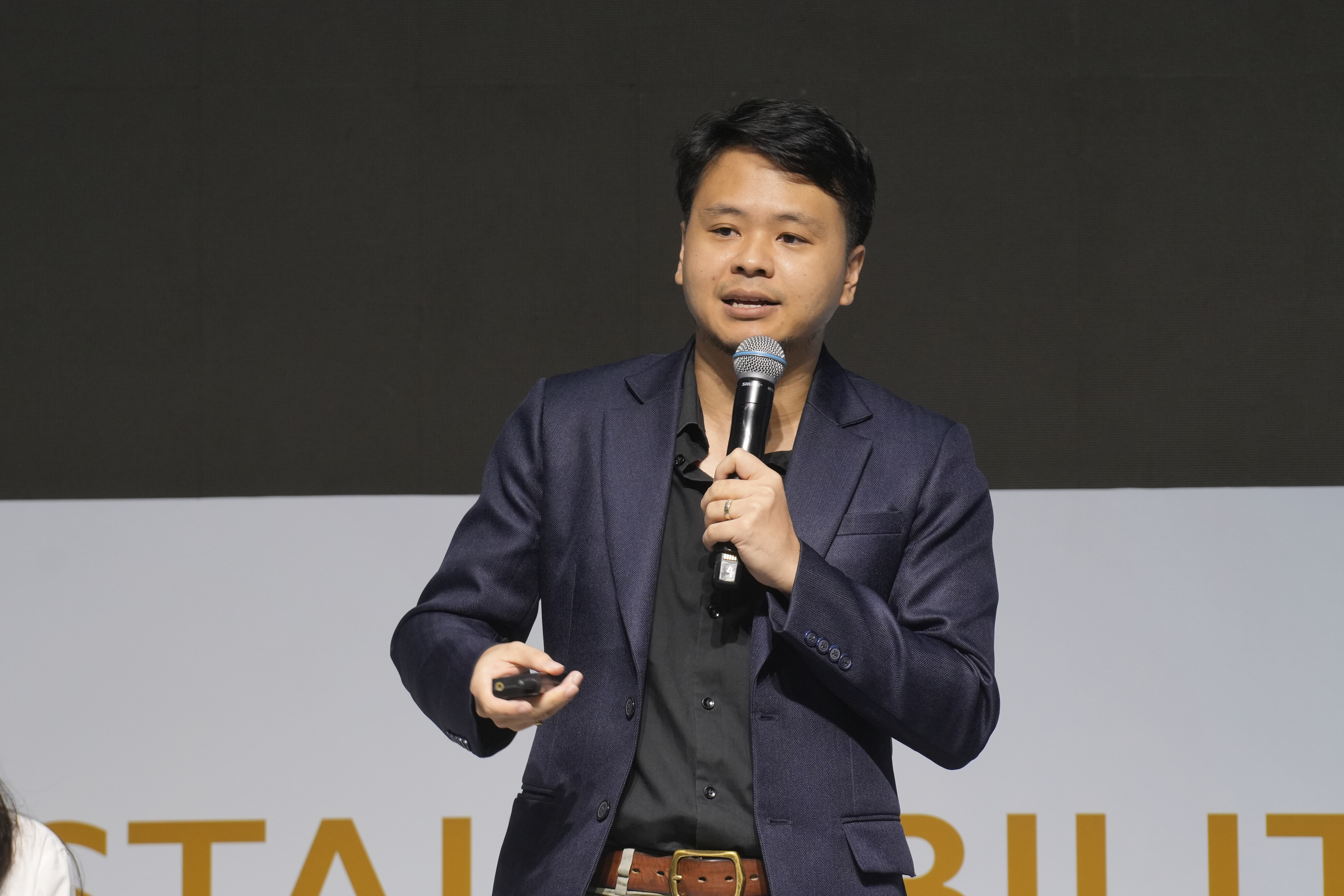
Instead, he proposed a middle path—what he called “opportunistic adaptation”—that fosters collective action and situational flexibility. Dr. Polpat advocates for the use of the Building Lifecycle approach to determine where, when, and how to adapt. He shared a case study from Bangkok’s Lat Krabang district, where researchers assessed the life expectancy of buildings and roads to predict areas that will require intervention within the next 100 years. This data-informed planning allows for tailored, flexible solutions that fit the local context.
He referenced global examples of flood-adaptive design, where riverbanks and floodplains are transformed into multifunctional public spaces—parks in the dry season that double as flood basins during monsoon periods. “As architects and designers, we are the bridge between communities and policymakers,” he concluded. “If we can help both sides envision a better future together, we can collectively take action to adapt.”
Learning from Nature
Chutyawej Sindhuphan emphasized that climate change is a long-term transformation that will increase poverty and displacement across the globe. “Global temperatures have already risen by 2 degrees Celsius—faster than projected by over a century,” he warned. But nature, he argued, always seeks balance. Human interference—like deforestation, deep-sea fishing, and urban sprawl in river deltas—has disrupted this balance.
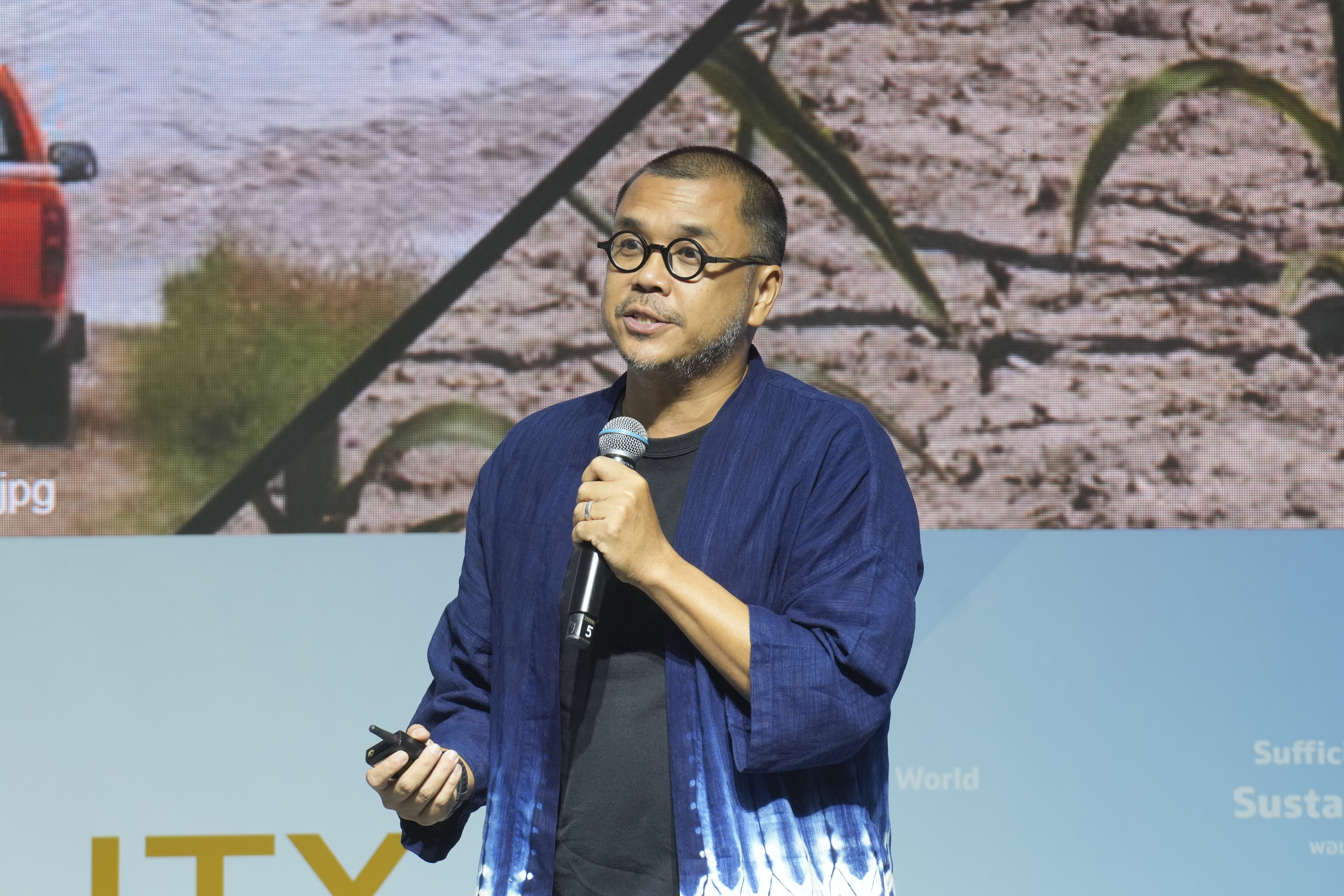
Drawing inspiration from Charles Darwin, Chutyawej cited the orchid species in Madagascar with a 20-centimeter nectar spur, which led Darwin to predict the existence of a moth with a long tongue. Over 100 years later, such a moth was indeed discovered—proof of nature’s intrinsic balance. In Thai forests, wild gaur (a large species of bovine) keep vegetation in check, while tigers control gaur populations—each species playing its role in a finely tuned ecological system.
He argued that modern urban planning must draw lessons from the natural world. “Traditional cities were designed with organic forms that followed natural land contours—similar to leaf veins—because early settlers considered the land’s characteristics before building,” he explained. Inspired by fire ants that form floating colonies, he proposed the concept of floating cities, where every citizen has a designated role—food growers, energy producers, waste managers, and so on.
Chutyawej also cited the National Housing Authority’s experimental Amphibious Houses in Ayutthaya, which flood annually, as a local example of adapting architecture to nature rather than fighting it. “Restoring balance requires letting nature heal itself,” he said. He praised the Mae Fah Luang Foundation’s forest restoration model, which focuses on empowering people to care for the land instead of harming it.
“Thailand has the philosophy of Sufficiency Economy,” he continued. “It teaches self-awareness, moderation, and ethical development—sustainable progress that doesn’t conflict with nature.”
Chutyawej ended on a personal note: “I used to own nearly 30 cars. Now, I drive a second-hand one from my aunt that’s over 20 years old, and I bike most places. If we want to make our cities better, let’s first ask ourselves—have we been part of the solution?”
Stay updated with the latest from SX via Facebook: Sustainability Expo or Line Official: @sxofficial
Get inspired and discover real-world examples of sustainable change at SX2025, returning in full scale from September 26 – October 5, 2025, at the Queen Sirikit National Convention Center.